Asus Eee Pad Memo ME171 (Dual-core Processor 1.2GHz; 7-inch display)

CNET Editors' Rating

0 star

Average User Rating

0 star

Be the first to review

I Own it 8 I Want it 53 Not for me 7

The Asus Eee Pad Memo is one elusive tablet. 

After making its debut at last year's CES, where this 7-inch slate was revealed to be a hybrid device that has a stylus and is able to make phone calls, we didn't hear anything from Asus until Computex. At that tradeshow, the company revealed a glasses-less 3D version. And just when we were wondering if the Memo was merely vaporware after going missing for the rest of 2011, Asus introduced a US$249 Tegra 3-powered slate bearing the Memo branding at this year's CES.

It turns out that there are two versions, the stylus-equipped Memo ME171 and the Tegra 3 version that's known as the Memo 370T. While we would have preferred the Memo 370T, we could only get our hands on the ME171. Here are our early impressions of this hybrid device.

Upside

We have been seeing a resurgence of the stylus. Samsung isn't shy about it on the Galaxy Note and other manufacturers such as HTC and Lenovo already have stylus-equipped tablets in the market. By placing it horizontally at the side of the unit, the Eee Pad Memo is a different take on where to store the stylus when not in use. From our time with the Memo, we feel that it's actually a more convenient location than the usual top corner preferred by other stylus-equipped slates.


The stylus is located below the Memo's screen. (Credit: Vincent Chang/CNET Asia)

The Memo's 7-inch display comes with a 1,280 x 800-pixel resolution and though it seems to pick up fingerprints easily, a protective layer of Gorilla Glass should ensure that it won't be easily scratched.

Despite being more than a year old, the hardware on the Memo remains current. It has a dual-core Qualcomm processor running at 1.2GHz with 1GB of onboard RAM. It's not exactly Tegra 3, but it should be competitive with most Android tablets in the market. 


Locate your Memo tablet or MeMIC using the other device. (Credit: Vincent Chang/CNET Asia)

Asus has included a companion device known as MeMIC, which is a small handset with a transparent screen. It connects to the Memo via Bluetooth and you can then receive and make phone calls using this device without looking like a dork. You can even read SMS on the MeMIC, though obviously, you cannot reply to your messages as it has no keyboard. It can also act as a remote control for music playback.

Finally, you can locate the small MeMIC (once it's paired with the Memo) if you happen to misplace it using the built-in Manager app on the Memo. From the app, you can command the MeMIC to emit a loud alarm to help you find it. This works both ways, so you can find the Memo (if you lose the 7-inch tablet) using the MeMIC.

Downside 

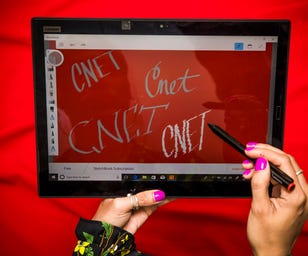
The rubber-tipped stylus isn't the most accurate of input devices. The tip is fairly thick and we found it difficult to write with it. Asus includes a note-taking and a paint app to take advantage of it, but we found ourselves struggling as the stylus just lacked the required precision.

The Memo ME171 was first showcased early last year and you can tell from its design, which is more similar to the Asus Eee Pad Transformer than the Transformer Prime. As 7-inch tablets go, it's not the lightest (400g) and the chassis is fairly thick at around 12mm.
 
While Asus has assured us that the Memo will get an Ice Cream Sandwich (Android 4.0) update, it comes preloaded with Android 3.2 and there's no official confirmation on when this upgrade will take place.

Outlook

With its ability to make phone calls and 7-inch form factor, the Asus Eee Pad Memo is likely to be compared with the original Samsung Galaxy Tab. While we can't see ourselves using such a hybrid device, especially when Asus has the Padfone, another hybrid smartphone and tablet, in the pipeline. There's also no word yet on pricing and availability for the Memo.


The Asus Eee Pad Memo has a 5-megapixel camera at the back and a 1.2-megapixel front camera. (Credit: Vincent Chang/CNET Asia)


The microSD and SIM card slots. (Credit: Vincent Chang/CNET Asia)


At the bottom, you'll find the micro-USB port used also for charging and a micro-HDMI port. (Credit: Vincent Chang/CNET Asia)
Vincent Chang
About the author

After years of reviewing the innards of PCs in his previous job, Senior Writer Vincent Chang has moved on to covering notebooks and PC systems at CNET Asia. A big reader of sci-fi and fantasy, he has accepted the inevitable and gone down the e-book route, though he's still resisting the siren call of the Kindle.

Be the first to comment

Sign In with or create an account to post a review.


The posting of advertisements, profanity, or personal attacks is prohibited.