Print     Email     Bookmark     Share

How to choose a flat-panel TV

In today's modern home, the television has become the heart of the entertainment system, be it watching TV programs and movies, playing console games or even surfing the Web. In fact, with prices dropping to mainstream levels over the last couple of years, flat-panel TVs have become a must-have item for many consumers. However, there are so many choices out there, finding the right one can be daunting for the average buyer. Do you go for LCD or plasma? What screen size is ideal for a bedroom? For a more indepth guide, you can check out the Living Room guide.

The space you have

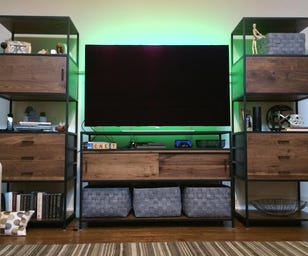
If you have limited space in your bedroom, you may want to consider wall-mounting the TV panel. But if you must put it on a stand, ensure that the TV is positioned at eye level which gives the best view. For smaller LCD panels, these can be placed on a desk to double as a PC monitor. As far as possible, try to take room lighting into consideration when deciding where to place the TV. Electrical lighting and sunlight can cause glare on the screen which makes the colors look faded and washed-out. In such cases, LCDs generally hold up better in brightly lit rooms due to their matt screen finish.

Your viewing requirements

Know your distance:
You really don't want a large screen TV that overwhelms the whole bedroom. Thus, it's important to decide where you will be seating to watch TV most of the time, then find a screen size that matches the viewing distance. The optimal viewing distance for a widescreen TV should be about 1.5 to three times the diagonal screen size. So for a 26-inch TV, this is best viewed from 3.3-6.5ft away. Generally, the picture quality tends to drop as you get closer to the TV, and looks small if you sit too far away. Best Buy has a reference guide for both standard flat panels and HDTVs. DTV City has a calculator if you want to work backward to calculate the screen size based on the viewing distance you have.

Screen size Suggested max. viewing distance
27-inch 6.75ft (standard) | 5.67ft (HDTV)
32-inch 8ft (standard) | 6.67ft (HDTV)
37-inch 9.25ft (standard) | 7.75ft (HDTV)

LCD vs. plasma:
In a bedroom setting, LCD TVs are typically preferred over plasmas. This is because LCDs are available in smaller screen sizes and relatively thinner and lighter, making them suitable for Asian bedrooms which are typically small. Besides, the higher resolution of LCD panels compared with plasmas is useful for those planning to multitask the TV as a PC monitor. Consider a plasma TV only if you have a large DVDs collection and desire the deep blacks offered by technology, in addition to having the room space for a 40-inch or larger panel for a more complete movie viewing experience.


LCD

LCD

  • Wide range of screen sizes from 15 to over 60 inches
  • Available in 1080p full-HD resolution at smaller sizes
  • Relatively thinner and lighter, easier to install
  • Uses less energy than plasma
  • Limited viewing angle compared to plasmas
  • May have stuck (or dead) pixels
  • Potential for motion blur
Plasmas

Plasma

  • Known to produce deeper blacks than LCD
  • Better at handling fast-motion images
  • Better contrast and brightness than LCDs
  • Available in larger sizes only, from 40 to over 60 inches
  • May suffer burn-in effects
  • Generally lower resolution than similar-sized LCD
  • Glass surface reflects light
  • Runs hotter, needs ventilation space around

Full-HD or not?:
A full-HD panel (also commonly known as 1080p) usually refers to a progressive-scan TV with a native resolution of 1920 x 1080. This is the highest HD resolution that can be found on commercial TVs. For this reason, they are also the most expensive. (The other two HD formats, 720p and 1080i, is more commonly supported on many mainstream panels). Unless you have a big room, a full-HD (1080p) panel is usually not recommended for use in a bedroom environment. This is because full-HD TVs are generally quite big. The smallest 1080p panels in the market are about 42 inches for an LCD TV and 50-inch for a plasma. A full-HD panel has the advantage of a higher resolution, but the difference is noticeable only in panels larger than 40 inches.

Other features:
When buying a flat-panel TV, you may want to keep an eye out for other important features such as the contrast ratio, the bundled remote control unit, the type of connectivity options offered on the TV and useful extras like the onboard memory card slots.

Your budget

The thing about shopping for a flat-panel TV is that there is a tendency to get carried away and end up buying a panel that's bigger and more expensive than what you originally set out to get. It's always tempting to pay a little more for something bigger and nicer. Thus, it's important to set a budget and to stick to it. These days, you can find 32-inch LCD panels for below S$1,000 and 37-inch models going for around S$1,500. 40- and 42-inch TVs can also be found for less than S$2,000. TVs above 46 inches are generally still priced at a premium, but it shouldn't be long before they become more affordable.

Product Showcase

Samsung Series 6 LCD TV

Samsung Series 6 LCD TV

With exquisite balance and unique harmonious qualities, the LCD TV Series 6 reflects nature's essential elements.
 More Samsung products

Samsung Series 5 LCD TV

Samsung Series 5 LCD TV

With its elegantly stylish design the Samsung LCD TV Series 5 enables you to enjoy quality and versatility that indulge all of your senses.
 More Samsung products

Samsung Series 4 LCD TV

Samsung Series 4 LCD TV

With a design that is simply refined, the Samsung LCD TV Series 4 delivers delight to your eyes and creates entertainment that is more enjoyable.
 More Samsung products


Find the right
Samsung product

Not sure which product you should buy?

 Get help

Videos from
Digital Home DIY

Digital Home DIY Videos

Get Adobe Flash player